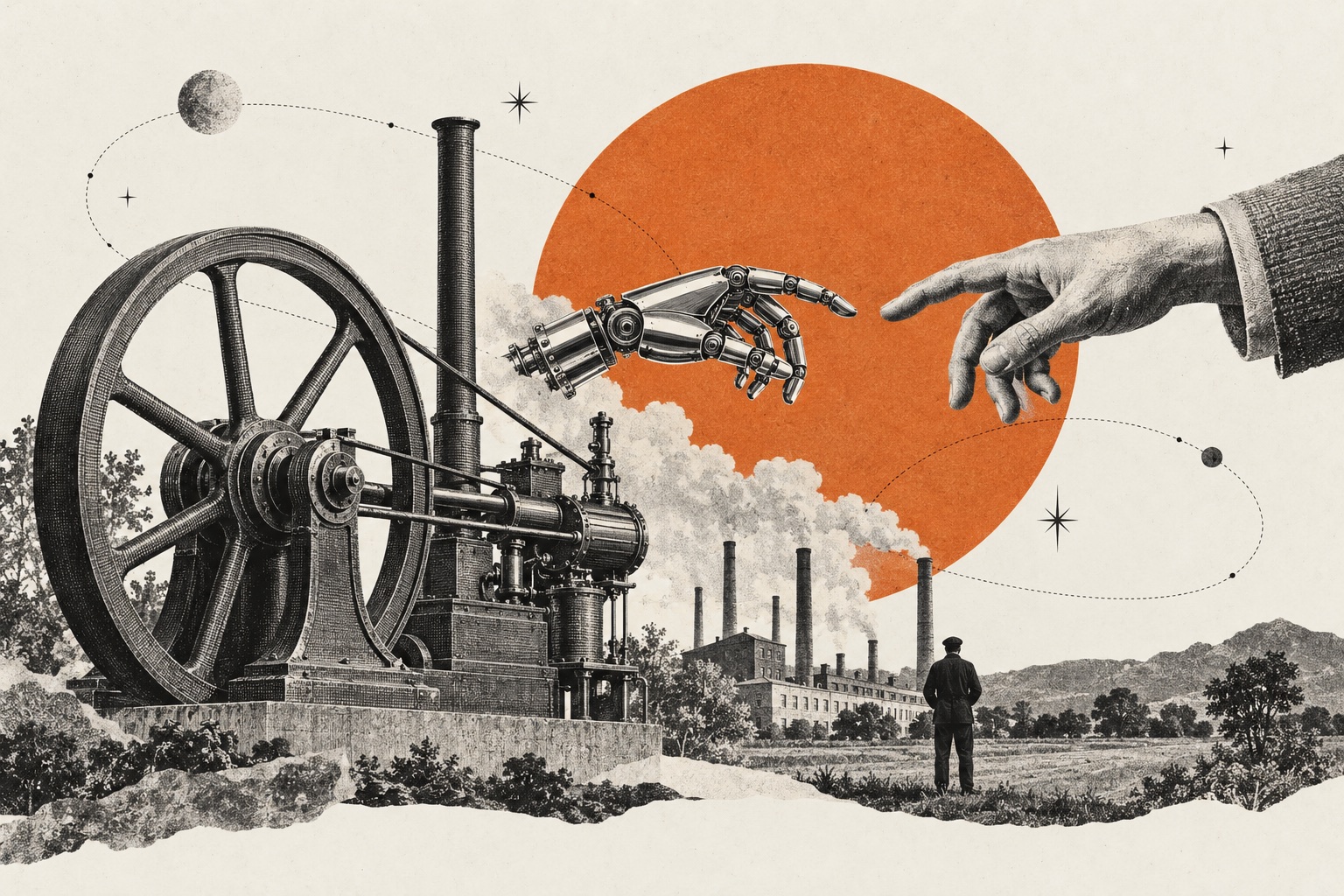
If a machine saves an hour,
who gets that hour?
A worker can make the same thing in half the time. Does that mean a shorter day, twice as much output, a lower price, or one less job?
The machine alone cannot answer. It changes what is possible. Prices, demand, ownership, bargaining power, and institutions help decide what happens next.
Conceptual diagram: these are possible channels, not inevitable outcomes.
This week’s question sits at the intersection of two ideas. Productivity is how much we produce for a given input. Distribution is how the gains and costs are shared. Confusing the two makes the history of automation look much simpler than it is.
Working hypothesis: technological progress expands the menu. It does not choose the meal for us.
We’ll follow a selective path through industrial Britain and later economic thought. It is one influential strand of the story, rather than a complete global history of technology.
New machines.
Remarkably familiar questions.
Start anywhere on the timeline. These are moments when the argument changed, not a claim that progress moved neatly from one stage to the next.
A pin factory changes the scale.
Smith describes workers dividing pin-making into specialized operations. Coordination, tools, and practice make an extraordinary difference to output. The first lesson is about organizing work, before it is about replacing workers.
Read the source ↗The Luddites ask who pays.
Beginning in 1811, textile workers protest machinery and changes to their livelihoods. The surviving letters and notices reveal disputes over pay, skills, and control. Their story makes more sense when we look at working conditions as well as machines.
Read the source ↗Ricardo separates profit from wellbeing.
In a new chapter on machinery, Ricardo acknowledges that owners can benefit while workers lose employment. He still sees potential long-run gains, but no longer assumes every class automatically benefits together.
Read the source ↗Marx looks at who owns the machine.
Marx argues that under capitalist production, machinery is used to increase surplus value. A tool that could reduce toil can instead lengthen or intensify work. Ownership and the organization of production shape the outcome.
Read the source ↗Keynes imagines a shorter week.
Writing amid economic crisis, Keynes looks a century ahead. He imagines rising living standards and a fifteen-hour workweek, while warning of technological unemployment during the transition. This is a conditional vision of possibility.
Read the source ↗Automation is only half the equation.
Acemoglu and Restrepo distinguish tasks shifted from labor to capital from new tasks that create demand for people. Productivity can rise while labor’s share falls. The balance between displacement and new work matters.
Read the source ↗Select a year to explore. With a keyboard, use the arrow keys within the timeline. Intervals are categorical, not proportional to elapsed time.
Four lenses.
One very old argument.
These thinkers are answering different questions. Read them as complementary and competing lenses, rather than a contest with one timeless winner. The summaries below are paraphrases.
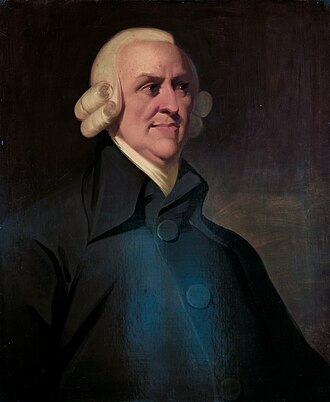
Adam Smith
1776 · PRODUCTIVITYMake the work more productive.
Specialization lets workers develop skill, avoid switching tasks, and use purpose-built tools. His pin factory shows why the organization of production matters.
The important nuance
Productivity is output per unit of input. It does not tell us how income or free time is distributed.
Original text ↗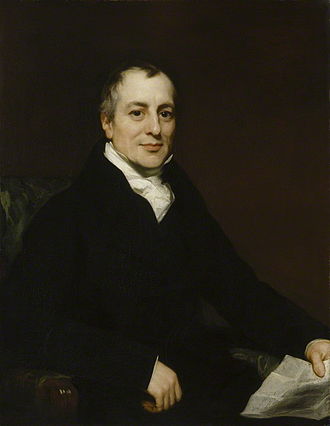
David Ricardo
1821 · DISTRIBUTIONA richer owner, a poorer worker?
Ricardo’s revised view allows profits to rise while demand for labor falls. A gain for the economy’s owners is not enough to prove a gain for its workers.
The important nuance
He did not conclude that machinery should be stopped. His point is that class interests can diverge during its adoption.
Original text ↗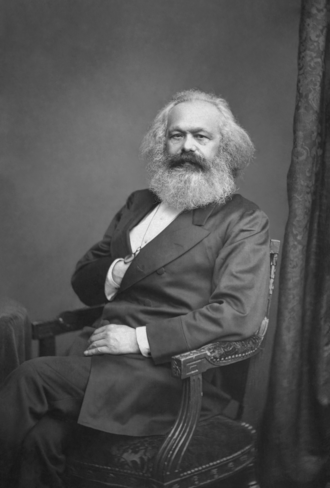
Karl Marx
1867 · OWNERSHIPWho controls the productive power?
Marx sees a conflict between the capacity to save labor and the use of machinery to extract surplus value. Technology’s social effects depend on the relations around it.
The important nuance
This is Marx’s theoretical lens, not an uncontested law. His account directs attention to ownership, bargaining, and control of working time.
Original text ↗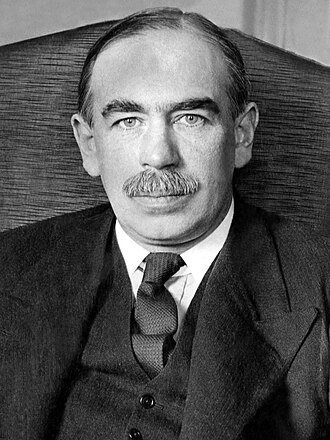
J. M. Keynes
1930 · LEISUREWhat if progress bought us time?
Keynes imagines productivity meeting material needs with much less work. He sees a difficult adjustment on the way to possible abundance.
The important nuance
The fifteen-hour week is a possibility tied to his assumptions about growth and needs, not a measured outcome or a guaranteed deadline.
Original text ↗Portrait credits and original texts are listed in the sources. Open each card for the qualification that a short summary can miss.
More stuff.
Or more life outside work?
Two historical examples reveal very different ways of imagining progress. Smith asks how much more a group can produce. Keynes asks what we might do once producing enough takes less of our lives.
Smith’s pin factory, per worker
PINS PER DAY · HISTORICAL ILLUSTRATION, 1776Inspect the numbers
| Work arrangement | Value | Basis |
|---|---|---|
| Independent, untrained | <20 | Smith’s comparison |
| Division of labor | ≈4,800 | ≈48,000 ÷ 10 workers |
The picture is dramatic. But it tells us about output, not about pay, security, or happiness. Those require other evidence. A productive factory can still leave a difficult question unanswered: how is the extra value divided?
“Three-hour shifts or a fifteen-hour week may put off the problem for a great while.”JOHN MAYNARD KEYNES · 1930 · Economic Possibilities for our Grandchildren
Picture Keynes’s fifteen-hour week.
ONE POSSIBLE ARRANGEMENT · EACH BLOCK = 1 HOURThe contrast gives us a useful question to carry forward: when productivity rises, how much becomes additional consumption, how much becomes income for different groups, and how much becomes time?
Same machine.
Different working day.
Imagine a workshop that produces 100 units in eight hours. Give it a more productive tool, then choose how to use the gain.
Keep the eight-hour day. At twice the productivity, output doubles to 200 units.
Illustrative arithmetic, not a forecast. Output = 100 × productivity multiplier × hours ÷ 8. We hold quality, staffing, and tool availability fixed, and leave out costs, prices, demand, and wages. “A bit of both” takes half of the maximum possible time saving and uses the rest for output.
Notice what the experiment cannot decide: who chooses the scenario, who owns the workshop, and whether workers keep their income when hours fall. Those are economic and political questions that the productivity number leaves open.
A job is a bundle of tasks.
A technology can remove one task and make another more valuable. In his 2015 essay, economist David Autor explains that automation can substitute for labor and complement it. Lower costs and greater output can also change demand. That helps explain why task automation has not historically translated one-for-one into disappearing jobs. [6]
A machine takes over a task.
Less labor is needed for that activity. Some workers may lose income, hours, or employment.
People do different work.
New activities and complementary skills can create demand for labor. The timing and beneficiaries may differ.
Acemoglu and Restrepo formalize the tension between automation and new tasks. Their framework helps us ask whether an innovation merely replaces labor or also creates valuable things for people to do. It does not promise that displaced workers will get the new jobs. [7]
My synthesis: the useful question for AI is more specific than “Will it take the jobs?” Which tasks change? Who gains bargaining power? What new work becomes possible? How quickly can people adjust, and who carries the cost?
History offers lenses for asking those questions. It cannot settle the pace or distribution of AI’s future effects.
Who gets the room to think?
What would we explore if every idea didn’t have to earn its place on an annual evaluation form?
I keep coming back to another use for the saved hour: following a question whose value I cannot yet explain. Could automation make room for that kind of curiosity—for trying to understand the universe, even when there is no obvious box to tick?
Three things worth separating.
Cognitive offloading
Putting some mental work into the world: writing a note, setting a reminder, or using a calculator. It reduces the demands of a particular task. [9]
Creative incubation
Setting a problem aside and returning to it later. A break may help an idea develop; the kind of break and problem matter. [10]
Freedom to explore
Having time and support to pursue an uncertain question, including permission for early attempts to fail. This is also a question of institutions. [11]
Leaving Cambridge during a plague is not itself cognitive offloading. And a tool that handles a calculation does not automatically give its user control over the rest of the day. Those are separate steps in the argument.
Where could that hour go?
More of the known work.
More tasks completed. The same questions, with a higher target.
Room for a different question.
Read across fields. Follow an anomaly. Try something that might fail.
What the evidence lets us say.
In a 2012 experiment, Baird and colleagues found that an undemanding task during a break improved performance on previously encountered “unusual uses” problems more than a demanding task, rest, or no break. That condition also involved more mind wandering. This is evidence about a specific creative task, not proof that downtime produces scientific theories. [10]
The connection to evaluation is more direct in a 2011 study by Azoulay, Graff Zivin, and Manso. They compared life scientists funded by HHMI, with latitude to experiment and tolerance for early failure, with similarly accomplished NIH-funded scientists. HHMI investigators produced more high-impact papers and moved into more novel research directions. This was an observational comparison of funding arrangements, not a randomized test of abolishing annual evaluations. [11]
My working hypothesis: reducing routine mental work may help discovery when people also have the time, knowledge, and freedom to choose what to think about next.
I would want evaluation to leave room for a well-explored dead end, an unexpected connection, or a better question. Otherwise, we risk using our new tools only to fill the old boxes faster. The economic question comes back into view: who can afford to explore without an immediate payoff?
Busy doing what?
Before we ask how to do a task faster, can we explain why it needs doing?
Anthropologist James Suzman brings a cultural question to this edition: why do we keep organizing life around paid employment as machines become more productive? In this interview, he argues that some work persists because our institutions expect everyone to have a job. He also imagines more time for work people choose—making, learning, and creating. [12]
Why so many people work “bullshit jobs”
James Suzman · Big Think · 2021
I connect this to the question about annual evaluations: could the effort spent proving that we are busy crowd out the effort needed to understand something? That is the connection I want to explore, rather than an endorsement of every claim in the video. In particular, productive abundance does not by itself establish that everyone’s material needs are met.
Graeber’s provocation.
David Graeber developed the “bullshit jobs” argument in a 2013 essay and a 2018 book. His starting point is work whose existence the person doing it cannot justify. The judgment concerns the job’s purpose; it is not a measure of the worker’s worth. [13]
For this notebook, I want to ask a narrower question about tasks inside otherwise useful jobs. A researcher can do valuable science and still spend time duplicating information that nobody uses. Equally, a slow, repetitive task can be essential to reliable science.
Document an experiment.
Another person can reproduce the method, spot an error, or understand a failed attempt. The record has a use even when the experiment does not succeed.
Duplicate an unused report.
Suppose the same information is copied into another form, and nobody uses it for decisions, accountability, or learning. What purpose does the extra step serve?
Hypothetical examples, not claims about a particular workplace. Usefulness can be indirect or become visible later; an uncertain research outcome is not evidence of a pointless task.
Keep the argument open: what does the evidence challenge?
Soffia, Wood, and Burchell’s study, first published online in 2021, used European survey data to test Graeber’s theory. They found a low and declining share of workers describing their work as useless, contrary to its central claims. They emphasized management and working relationships as an alternative explanation for perceived meaninglessness. [14]
These are reports of experienced usefulness, not an objective inventory of every job’s social value. The debate helps us distinguish a job’s purpose, its design, and how it feels to do it.
The question I’m taking back to AI: will we use it to remove unnecessary work—and protect the time recovered—or simply produce more evidence that we are busy?
Four dots to connect.
- Productivity and prosperity are different claims. More output per hour does not tell us who has a better life.
- The transition has a human timescale. Gains somewhere in the economy do not erase a particular worker’s loss.
- The rules shape the result. Ownership, institutions, bargaining, and new tasks help determine what happens to the gains.
- Saved time needs purpose and room for curiosity. Ask which tasks are worth doing, who controls the recovered time, and what the institution rewards.
Try explaining it: why can output rise while workers lose?
A new machine can make each hour more productive while reducing the number of hours or people a firm needs. Total output and profits can rise even as some workers lose earnings. New demand or tasks can offset losses, but that is a separate process, with different timing and beneficiaries.
Have a different reading or a source I should see? Send a thought or correction ↗
Don’t take the notebook’s word for it.
Start with the original arguments. Publication years below refer to the works, not the dates their digital copies were uploaded. This edition’s research was checked on October 4, 2026.
-
Adam Smith · 1776
The Wealth of Nations, Book I, Chapter I ↗The division of labor and the pin-factory example. This is an account in a historical text, not a modern controlled study. -
Workers’ perspectives · 1811–1816
Why did the Luddites protest? · The National Archives ↗Letters, petitions, and notices documenting conflict over machinery, wages, and working conditions. -
David Ricardo · 1821
On the Principles of Political Economy and Taxation, Chapter 31: On Machinery ↗The chapter added in the third edition, revising his earlier position on machinery and workers. -
Karl Marx · 1867
Capital, Volume I, Chapter 15: Machinery and Modern Industry ↗Machinery, surplus value, the working day, and the distinction between technology and its capitalist use. -
John Maynard Keynes · 1930
Economic Possibilities for our Grandchildren ↗His essay on technological unemployment, material abundance, and a possible fifteen-hour week. -
David Autor · 2015
Why Are There Still So Many Jobs? ↗Journal of Economic Perspectives 29(3). Why automation can substitute for tasks and complement human labor. -
Daron Acemoglu & Pascual Restrepo · 2019
Automation and New Tasks: How Technology Displaces and Reinstates Labor ↗Journal of Economic Perspectives 33(2). A framework for displacement, productivity, and new tasks. -
Isaac Newton · historical record
The Newton Project: Life and Work at a Glance ↗ Chronology of his studies, plague-year work, later publications, and Leibniz’s independent development of calculus. Read alongside Newton’s draft letter to John Wallis ↗, which revisits dates and acknowledges earlier mathematical reading. A historical case, not a causal experiment. -
Evan F. Risko & Sam J. Gilbert · 2016
Cognitive Offloading ↗ Trends in Cognitive Sciences 20(9), 676–688. A review of how actions and external aids change a task’s cognitive demands; not a demonstration that offloading generates new theories. Author-hosted PDF. -
Benjamin Baird and colleagues · 2012
Inspired by Distraction: Mind Wandering Facilitates Creative Incubation ↗ Psychological Science 23(10), 1117–1122. A laboratory experiment on breaks and creative problem solving; improvements concerned previously encountered unusual-uses problems. University research record and DOI. -
Pierre Azoulay, Joshua S. Graff Zivin & Gustavo Manso · 2011
Incentives and Creativity: Evidence from the Academic Life Sciences ↗ RAND Journal of Economics 42(3), 527–554. An observational comparison using propensity-score weighting and difference-in-differences. Relevant to research incentives; it does not isolate annual appraisals or AI use. Author’s page, with paper and DOI. -
James Suzman · Big Think · 2021
Why so many people work “bullshit jobs” ↗ The video that prompted this section. Suzman’s perspective on work culture, technology, and chosen activity. Publisher’s transcript ↗. Read as an argument to examine, not a settled empirical account of all work or scarcity. -
David Graeber · 2013 / 2018
On the Phenomenon of Bullshit Jobs: A Work Rant ↗ The original 2013 essay, followed by the 2018 book Bullshit Jobs: A Theory. His 2018 interview ↗ explains the definition in his own words. Both are hosted in the David Graeber archive. -
Magdalena Soffia, Alex J. Wood & Brendan Burchell · 2021 / 2022
Alienation Is Not ‘Bullshit’: An Empirical Critique of Graeber’s Theory of BS Jobs ↗ Work, Employment and Society 36(5), 816–840. First online in 2021; journal issue in 2022. Tests five propositions using European survey data and challenges the theory’s account of prevalence and growth.
Image credits & how the visuals were made
The cover is an AI-generated editorial collage, not an archival photograph. Charts and diagrams are original HTML/CSS visuals; sources, units, and assumptions are stated next to them. Thinker cards use historical portraits from Wikimedia Commons, locally hosted. They are shown in grayscale via CSS.
- Adam Smith, the Muir portrait · historical portrait, public domain.
- David Ricardo by Thomas Phillips · public domain.
- Karl Marx by John Jabez Edwin Mayall, 1875, restored · public domain.
- John Maynard Keynes, 1929 · public domain in the United States.


.jpg)
A little less fog, perhaps.
Take the question with you. Share it with someone curious.